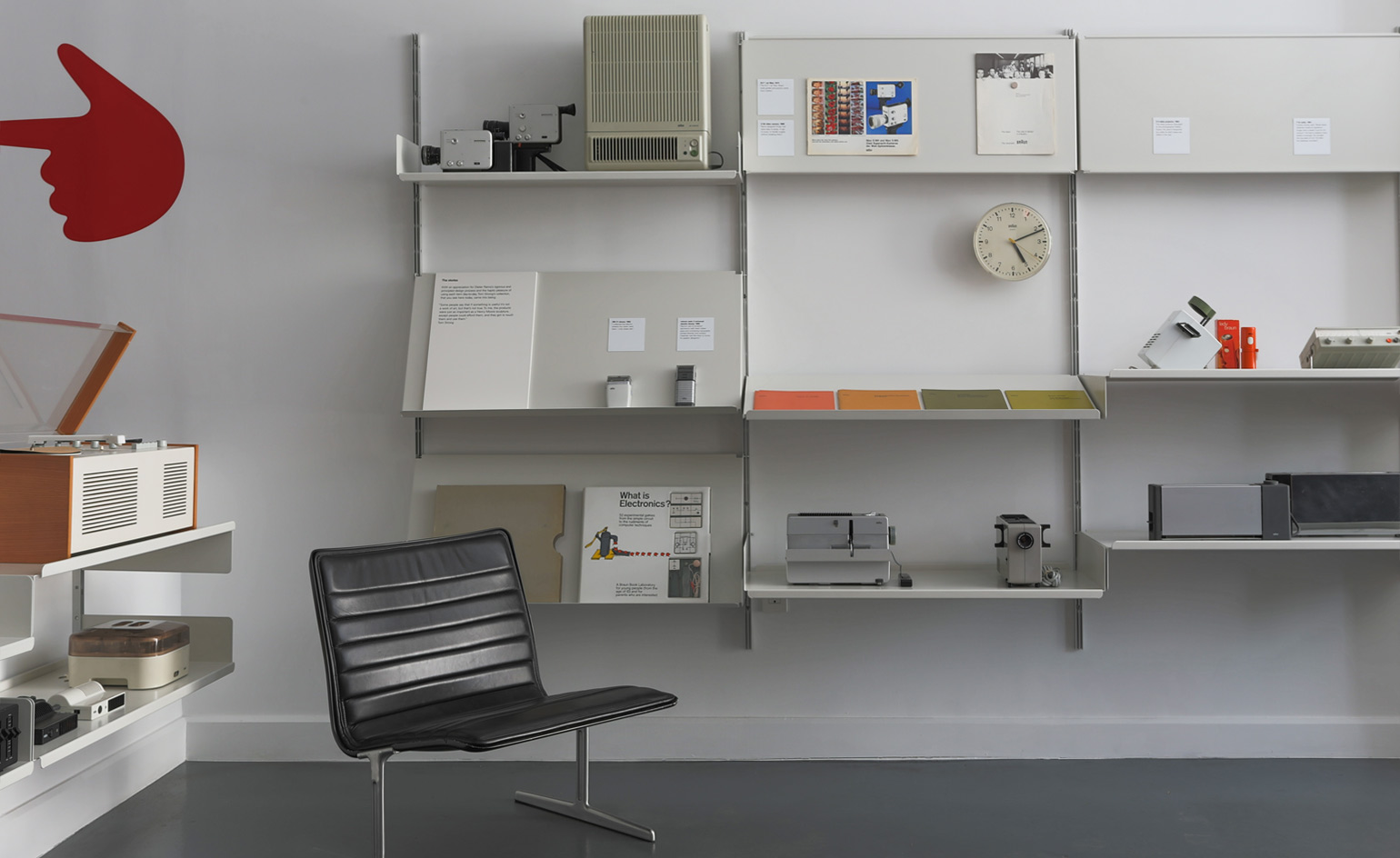
*Wall display using Dieter Ram's multi-modal shelving unit
Who is Dieter Rams?
“Indifference towards people and the reality in which they live is actually the one and only cardinal sin in design.”
—Dieter Rams
Even if the name Dieter Rams feels unfamiliar, the world he helped shape is deeply recognizable. The clarity of today’s touch interfaces, the quiet logic of a well-placed indicator dot, the stackable white shelving units that disappear into the background—these echoes trace back to Rams’ lifelong effort to make the built world more intelligible, humane, and durable.
Rams spent more than forty years at Braun, eventually becoming its Chief Design Officer, where he championed a design philosophy rooted in restraint, legibility, and longevity. His teams developed products whose influence far exceeds their mid-century origins: from the SK-4 record player with its transparent acrylic lid, to the ABW 41 switch with its tactile cue, to the T 1000 radio whose modular clarity would later inspire generations of electronics—from Sony to, most famously, Apple under Jonathan Ive. But Rams’ impact extends beyond specific objects. It rests in the method: a disciplined, systems-oriented approach to design that treated products as participants in everyday life, not disposable novelties.
Decades before “sustainability” became a design mandate, Rams warned of the dangers of a throwaway culture. Years before the digital turn, he questioned whether technology was empowering its users or quietly eroding their agency. His concerns feel uncannily contemporary: data abundance without comprehension, interfaces that nudge more than they inform, products whose opaqueness masks the predatory intentions behind their services.

*Comparison between Rams product design and Ives
15 Questions for Designers
Like many designers, I first encountered Rams through his well-known “10 Theses of Design” (see references below). Yet the aspect of his work that has stayed with me more deeply is not the list itself, but the sensibility behind it—a belief that designers bear responsibility for the long-term consequences of what they put into the world.
Buried in his archive is a lesser-known artifact: “15 Questions for Designers,” posed in a 1980 lecture reflecting on the designer’s role inside a company. These questions are less a checklist and more an ethical provocation. They ask what a product contributes to the user’s life, how it participates in a larger system, and whether the organization behind it is acting with integrity. They presuppose that design is not neutral—that making something is also a form of shaping behavior, expectations, and social reality.
As our contemporary landscape shifts from objects to subscriptions, from physical ownership to cloud infrastructure, and from discrete products to endlessly updating digital services, I find myself returning to Rams’ questions with renewed urgency. What happens when the “product” is no longer a radio or a shelving unit, but an interface that mediates attention, emotion, privacy, or identity? How should designers think about lifecycle when the artifact has no material form? What does “empowering the user” look like when the user interacts with invisible systems?
The following adaptation interprets Rams’ 15 Questions through a digital-age lens—honoring the spirit of his critique while extending it to the socio-technical systems we now inhabit. Original questions appear in black; my contemporary revisions appear in bronze.
- The first question is not if one should be designing something but how.
The first question is how, not what, not if.
- Is the product or feature that we are designing really necessary? Are there not already other, similar, tried and tested appliances that people have got used to and are good and functional? Is innovation in this instance really necessary?
- Will it really enrich people’s lives or does it just appeal to their covetousness, possessiveness, or ideas of status? Does it awake desire because it offers something new?
Will it enrich people's lives or does it capitalize on a human weakness?
- Is it conceived for the short- or long-term, does it just help increase the speed of the cycle of throwaway goods or does it help slow it down?
What does the update lifecycle look like, for how long? Does the product cease function after update support? Does the product have a local option, API, or secure alternative after updating stops?
- Can it be simply repaired or does it rely on an expensive customer service facility? Can it in fact be repaired at all or is the whole appliance rendered redundant when just one part of it breaks?
Can it be troubleshot or does it rely on expensive services and/or inaccessible knowledge? Are the fundamental mechanics transparent/accessible to the user? Are the entities in control of compute and data storage accessible and transparent to the user? Is the product able to be run locally or independently?
- Does it exhibit fashionable and therefore aesthetically short-lived design elements?
Do the design elements employed aim to make the end-buyer a "consumer" or a "utilizer"? Do the design elements employed make the product more understandable?
- Does it help people or incapacitate them? Does it make them more free or does it make them more dependent?
- Is it so accomplished and perfect that it perhaps incapacitates or humiliates you (user)?
- Which previous human activity does it replace and can that really be called progress?
- What possibilities for change, what scope does the product offer people?
- Can the product be used in other, perhaps playful, ways?
- Does the product really offer convenience or does it encourage passivity?
- What does the expected improvement look like in a broader context?
- Does it make an action or activity on the whole more complicated or simpler, is it easy to operate or do you have to learn how to use it?
When is friction in the user experience empowering, when is it a hinderance? What core mechanics behind the product should be made understandable to the user?
- Does it arouse curiosity and the imagination? Does it encourage desire to use it, understand it, and even to change it?
Is it able to be changed or contributed to? Is it able to be adapted?
References
- Rams, D. (1980, January 18). Die Rolle des Designers im Unternehmen [Speech]. Dieter Rams Archive (Collection 1.1.2.10).
- Lovell, S. (2024). Dieter Rams: As little design as possible. Phaidon.