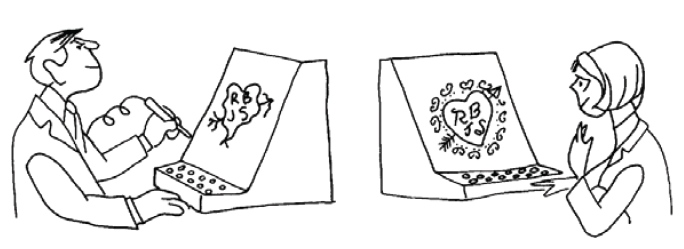
"The Computer as a Communication Device”, Original Illustration by Roland B. Wilson
Humans & Technology
I. Mythical Man Month
by Federick P. Brooks, Jr.
It's funny what things change and what things remain constant. This book brought as many chuckles as "Aha" moments as I got to read about key challenges associated with building a Software product and in general how most of those challenges stem from good Ol' people management or in this case a trial and error of lessons observed from mismanagement.
Here's the rub though, this book was written by one of IBM's leading project managers in 1975! It was a sum-up of sorts, of what he had learned over years of leading teams in creating the IBM OS's, the IBM System 360 being the one he was most well-known for. Written in 1975—I mean the Internet didn't even come out until the early 80's and personal computers hadn't even hit the market yet. 1975, and yet 80% of the advice in this book feels like its talking about the world today.
II. The Computer as a Communication Device
by J.C.R. Licklider and Robert W. Taylor
Going down the train of insane wisdom from those who came before, I was recommended this essay by J.C.R. Licklider. This essay was published in 1968 and in it not only does Lick predict the need for GUI (Graphical User Interface) he predicts the eventuality of the Internet and even predicts the use of AI.
At the time computers were seen as a tool to compute sums in the research or business space this essay was Lick's proposal that computers would have more impact as a tool for communication rather than just computation. A background in psychology, he paints in scary accuracy the world we live in now and explains the human drives behind why we would build such a world. It is an insanely fruitful read in both understanding the logic behind why some things may be what they are today as well as good food for thought as his predictions for AI may still be around the bend.
III. Employees
by Olga Ravn
This is a book where Sci-Fi meets poetry. Written as a report of employee statements gathered to assess productivity, this book not only takes you on a wild ride of questioning what it means to be human versus object but it will also make you question to what end do we strive to be productive, to be efficient? If humans were to reach the peak of productivity for what cause would it be in service to? and what might a human at peak productivity look like? Act like? Think like? Would they be a different species altogether?
IV. Sapiens
by Yuval Noah Harari
I admittedly have not finished this book, but at only 3 chapters in I'm already floored with new questions to think about, new observations of our society, and new angles by which to think. Blending a good pace of informational but not too technical, impartial yet still conversational, Yuval does a great job of combining biology, history, and economics to give a pretty comprehensive overview of how society formed and what major events shaped it to the systems we abide by today.
“Where the Sidewalk Ends”, Original Illustration by Shel Silverstein
Recreation
I. The Artists's Way
by Julia Cameron
Life-changing book for me. This book kicked off a year of change, of introspection, and of healthy honesty with myself. Although it's title gears itself towards artists, this book is actually a really powerful self-help book for anyone feeling stuck wanting to find direction in how to live a fulfilling and authentic life.
II. Interaction of Color
by Josef Albers
What I like most about this book is that Albers acknowledges that like a musician with a good ear or a cook with a good sensibility to taste, being able to use color well comes down to experiencing color in different contexts so that you can be more attuned to how colors act and react to different colors and different environments. Less of a formal methodology and more of a cookbook of exercises, this book will get you using color in a way that makes you think and notice the nuance.
“Where the Sidewalk Ends”, Original Illustration by Shel Silverstein
Fiction
I. Ender's Game
by Orson Scott Card
This is a reread for me, and years later it holds up so well. A Sci-Fi classic that mixes themes of philosophy with politics. For relaxed reading enjoy a story about a young strategic genius who is tasked with saving mother Earth from an invading alien army. For a deeper read, enjoy a story that asks “What ends justify what means?”.
II. Lockwood & Co.
by Jonathan Stroud
This is a fun series Will & I got into this year. Imagine Harry Potter meets Sherlock Holmes. In this world where ghosts attack people and the only ones able to detect and defend against ghosts are children, you'll find that not only is this a fun read about ghost mysteries but that you'll feel a renewed sense of eagerness and determination as it reminds you of how children would tackle very real problems instead of how a corporate world would.